

We’ve done electrical inspections at manufacturing plants, data centers, hospitals, and commercial buildings for years. After enough of them, you start to notice something: the buildings are different, the industries are different, the equipment is different. The problems are usually the same.
None of these show up because of bad management. Most of them build up slowly, a little at a time, which is exactly why they’re easy to miss. A facility manager running a busy operation doesn’t have time to watch for slow-moving problems. That’s what a scheduled inspection is for.
Here are the five industrial facility electrical problems we find on almost every job. For each one, we’ll walk through what it is, why it happens, how you spot it, and what it costs you if it gets left alone.
1. Loose Connections
Start with the physics, because it explains everything else. Metal expands when it gets hot. It shrinks back when it cools. Every time a circuit powers up, the metal parts inside it heat up and grow a little. Every time the circuit powers down, they cool and shrink back. That is thermal cycling.
Now think about how many times that happens. A motor that starts and stops through a shift. A panel that carries a production line all day and rests at night. Over years, that adds up to thousands of cycles. Each cycle moves the metal a tiny amount. The bolts, lugs, and clamps that hold connections tight slowly work loose. This is not a defect. Nobody installed it wrong. It happens in every building, and it happens to good equipment as much as bad.
The trouble is what a loose connection does once it starts. A loose connection has resistance. Resistance makes heat. The connection runs hotter, which loosens it more, which makes more heat. It feeds on itself. In a bad case that heat starts a fire. Short of that, it makes equipment fail or act strange for no reason anyone can point to.
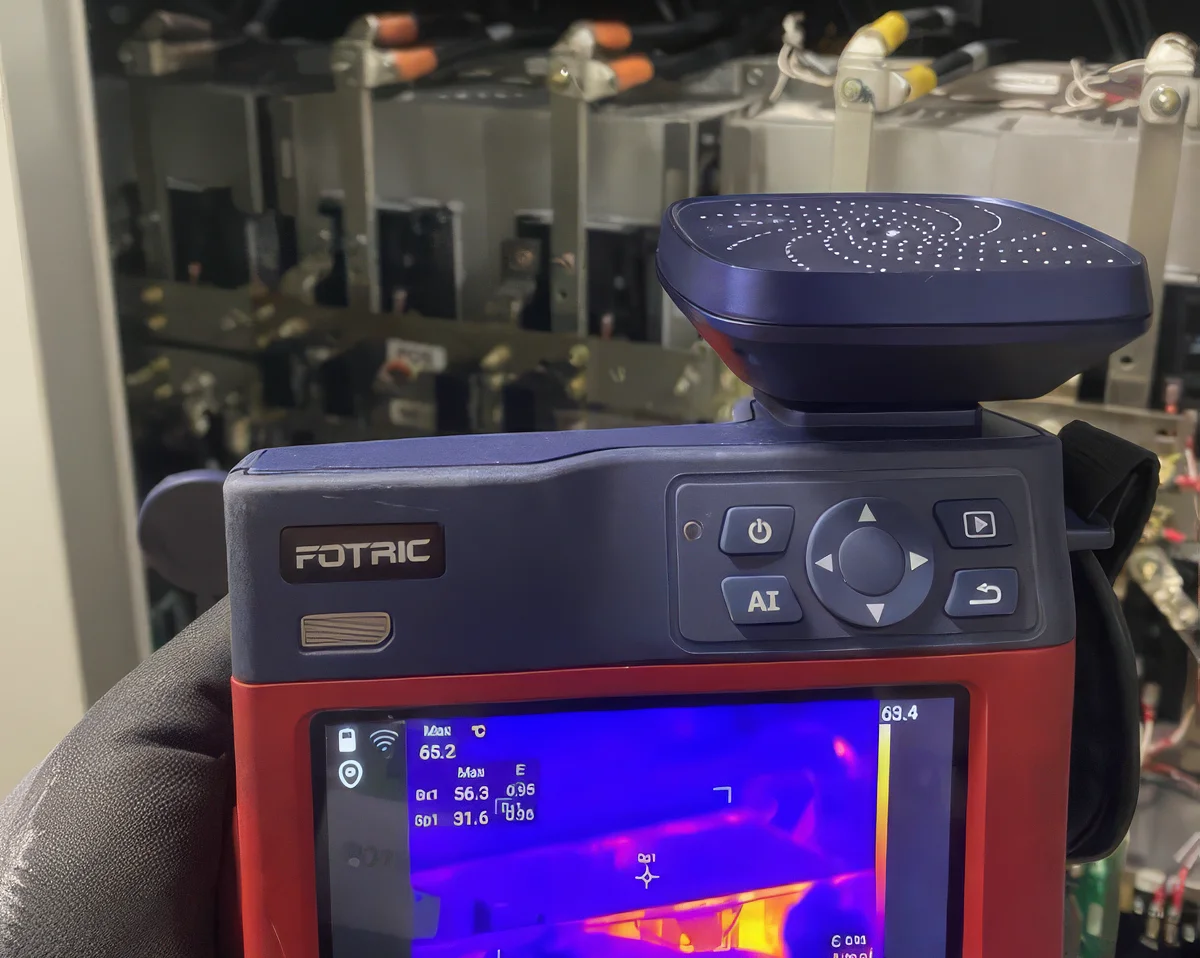
You cannot see any of this from the outside. The panel looks fine. Nothing trips. The equipment runs the way it always has. The only way to find a loose connection early is an infrared scan. On an infrared image, a loose connection shows up as a bright hot spot at a lug or a bus bar. It can run 20 or 30 degrees hotter than the metal right next to it. Caught at that stage, the fix is simple. Someone shuts the circuit down, tightens the connection to the right torque, and scans it again. Twenty minutes. Caught late, the same connection is a fire, a failed panel, or an outage that shuts down your line.
There are a handful of places we find these again and again. The main service entrance equipment, where all the power comes in. Motor control centers, especially older ones with a lot of individual starters that cycle all day. Distribution panels feeding production lines. And really any connection that has been in service more than 10 years without anyone checking the torque on it. If it has been carrying load and getting warm for a decade and nobody has put a wrench on it, it is worth a look.
Here is what it looks like when one is missed. A loose lug in a 400-amp breaker gets hot enough to cook the insulation around it. Cooked, carbonized insulation stops being an insulator and starts to conduct. Once that happens you have a fault path where there should be none, and that path can flash over into an arc flash. The equipment that was “running fine” two months ago fails all at once, and it takes the circuit and maybe a worker with it. The whole event traces back to one connection that a scan would have flagged.
2. Overloaded Panels and Circuits
This one almost never comes from a single bad call. It comes from five small ones spread over three years. An extra compressor gets added here. A new server rack goes in there. A production line gets upgraded and nobody thinks to run it past the electrical side. Each change on its own is inside the limits. Add them all up and the system is now carrying more than it was ever built to carry.
The panel does its best. It runs hotter than it was designed to run. Breakers start tripping more often. The equipment still works, so it is easy to just reset the breaker and move on. Nothing forces the issue, so nobody looks at the whole load. The real problem stays in place and gets a little worse each time something new gets plugged in.
On an infrared scan, an overloaded panel looks different from a loose connection. A loose connection is one bright point. An overloaded panel is warm all over. Breakers that should be cool are running warm. The bus bars show high temperatures across the whole panel, not just at one spot. When the heat is spread out like that, it points to load, not a single bad joint.
There is one thing worth knowing here, because getting it wrong makes things worse. Sometimes what looks like an overloaded circuit is really a breaker that was sized wrong when it was installed. A breaker that is too small for its circuit trips even when the load is fine. That is a different problem with a different fix. A truly overloaded circuit needs load taken off it or a larger feeder. A mis-sized breaker needs the right breaker. If you treat one like the other, you either leave a real overload in place or you put in a breaker that no longer protects the wire. A good inspection tells the two apart before anyone touches anything.
You can spot the warning signs yourself without any tools. If you are resetting the same tripped breaker more than once a month, that circuit is telling you something. If a panel feels not just slightly warm but noticeably hot to the touch, that is worth checking. If equipment on a circuit is running differently than it used to, slower, hotter, or with odd behavior, that can be a load or a supply problem. Any one of those is a reason to get eyes on the panel. A load assessment during an inspection gives you the full picture: where you are, how much margin is left, and what to fix before a circuit forces the decision for you.
3. Equipment Past Its Service Life
Switchgear, transformers, and circuit breakers have a service life. Some numbers help here. A quality circuit breaker in a well-kept room can run 20 to 30 years on its mechanical parts, the springs and contacts that make it open and close. But the protective side is different. The thermal-magnetic trip unit, the part that decides when to trip, can drift out of calibration over the years. So a breaker can look and feel fine, close and open just fine, and still not trip when it should. Switchgear built in the 1980s and 1990s is now well past the age where the original maker still stocks parts for it.
That parts problem is bigger than it sounds. When a breaker fails and it is a model that was discontinued 15 years ago, you have three ways out, and none of them are quick. You can hunt down a refurbished unit from a specialty supplier, which takes time and where quality varies from one supplier to the next. You can find a compatible replacement that may need the existing panel reworked to fit it, which is expensive and disruptive. Or you can replace the whole assembly, which is the most reliable answer and also the most costly. When a failure forces the choice, it is almost always that last, most expensive option that ends up happening, at the worst possible time.
Old equipment usually comes with a second problem: no history. Facilities that have changed owners, gone through renovations, or just run for decades often have equipment with no maintenance record at all. You do not know when it was last serviced. You do not know if someone unqualified has been inside it. You do not know if anything was done to it that changed its safety rating. You are flying blind on gear that carries your whole operation.
An aging equipment assessment fixes that. What it produces is a plain list: every major electrical component, its age, whatever service history is known, its last inspection date, its current condition, and a priority ranking for replacement or more testing. That list becomes the basis for capital planning. Instead of reacting to a failure and cutting a check under pressure, you plan the spend over the next one to five years on your own schedule. Most facilities have never been asked to think about their electrical system the way they already think about the roof or the HVAC. This is how you start.
4. Missing or Outdated Documentation
Start with the one-line diagram, because it matters more than any other document you have. The one-line is the map of your electrical system. It shows how power flows from the utility transformer, into your main switchgear, out through your distribution panels, and on to every piece of equipment in the building. In an emergency, the one-line is what tells your maintenance team which breaker to pull to cut power to a problem area without shutting down the whole facility. It is the difference between isolating one bay and going dark everywhere.
Now think about what happens when the map is wrong. Say the diagram shows circuit 14 feeding the production line in Bay 3. But five years ago, during a renovation, someone swapped feeders and never updated the drawing. In an emergency, the worker does the right thing. They follow the diagram. They pull circuit 14. The production line in Bay 3 stays live. The consequences run from a minor delay all the way to a serious injury, and the worker did nothing wrong. They trusted a document that lied to them.
You will run into three documentation problems most often. First, the original drawings are correct, but nobody updated them for the changes made over the years. Second, the drawings were never right to begin with, because the as-built documentation was never finished after construction. Third, there are no drawings at all, because the building went up in an era when they were not commonly kept, or they were lost when the facility changed hands. All three leave you working from guesses.
Good documentation is a short list. A current one-line diagram that matches the system as it actually is right now. A panel schedule for every distribution panel that shows what is connected to each breaker. Equipment records for the major components: transformer nameplate data, switchgear ratings, motor control center layout. And maintenance logs that show what was done and when. That is it. When those exist and stay current, every person who works on the system from that point on has something real to work from.
There is a compliance reason too. NFPA 70E requires an electrical hazard analysis before anyone works on energized equipment. You cannot do an accurate hazard analysis if you do not know how your system is wired. An arc flash study built on outdated or missing documentation is built on assumptions about what feeds what and how much energy is present. Those assumptions are exactly what get people hurt. We build this documentation from scratch for facilities that do not have it. It is one of the things that pays back the longest from any inspection program.
5. Deferred Corrective Work
This one is not a technical problem. It is an organizational one. And it may be the most expensive of the five.
Do the math on it. Electrical problems almost never get cheaper to fix with time. A loose connection that takes an hour to tighten today can become a full panel replacement and a production shutdown if it is left until it fails. And the findings that get pushed off are almost never the cheap ones. The cheap fixes get done. The expensive ones get deferred, which means the item most likely to hurt you is the one most likely to sit.
Here is why it happens, and it is not anyone being careless. Maintenance teams are stretched thin. Capital budgets get approved once a year. A finding that is not causing a failure right now gets pushed to next quarter’s budget. Then next year’s. Then it just becomes part of the facility’s permanent backlog. Nobody made a bad decision at any single step. The system quietly pushed the work forward until it became invisible.
The way out is real prioritization. Not every finding is equal, and your finding list should not treat them as equal. A loose lug in a small panel feeding a storage room is not the same priority as a loose lug in the main service entrance. A good maintenance contractor gives you a finding list ranked by risk, so you know what to spend on first. If your preventative maintenance contractor is handing you a list of everything they found in the order they happened to find it, ask for it ranked by risk instead. That one change turns a pile of findings into a plan.
And weigh the cost of a forced outage against a planned one. A planned outage for corrective work gets scheduled during a slow period. Equipment is coordinated, spare parts are staged, and the work takes a known amount of time. A forced outage, because something failed, happens at the worst possible moment with no preparation. The repair usually runs three to five times what the planned version would have cost, and that is before you count the lost production. Deferring the work does not save money. It just moves the bill to a worse day and adds interest.
How to Know If Your Facility Is in Good Shape
You do not need a maintenance program already running to find out where you stand. An initial inspection gives you a baseline. It finds the loose connections, identifies the overloaded panels, documents what you actually have in the building, and flags the corrective work that has been deferred. Once you have that, you can make a plan instead of reacting to whatever fails next.
A good inspection produces a written report. Every finding is documented, photographed where it helps, and prioritized by risk. You walk away with a clear picture of what needs to happen and in what order, not a vague sense that things are “probably fine.”
None of these five problems are unavoidable. Every one of them shows up on a proper electrical inspection before it causes a failure. A solid maintenance program finds loose connections before they start fires. It catches overloaded panels before they become reliability problems. It keeps your documentation current so your team can work safely. And it gives you a clear record of what has been found, what has been fixed, and what still needs attention.
That is the difference between managing your electrical system and being managed by it. If your facility has not had a full electrical inspection in the last two years, or if you have outstanding findings you have not had time to address, those are worth looking at soon.